Saturday, February 25, 2017

Letter to Kaneko

What would such a letter look like?
Talked to Oliver with Veronica about FIA and him.
Watched "The Kingdom of Dreams and Madness" about Miyazaki.

In the film Miyazaki tells a letter he received from a man who had a strong memory of Miyazaki's father during the war years. This man was a four year old boy during the war when his family's home was destroyed while Miyazaki's home was not. The family was homeless and looking for refuge. They came across an empty home an rested in the genkan. Some time later Miyazaki senior came home to get something from the house. The family apologized and was about to go when Miyazaki's father came back from inside the house with chocolates for the family. Miyazaki said that it had obviously make a huge impression on the man for him to write so many years later - he was 76 when he wrote the letter. Miyazaki imagined that it had made a difference in how the man had looked at life since then -that it had made him an optimist. Miyazaki says, "Imagine being welcomed instead of being kicked out!"

I guess Kaneko has been an inspirational figure. He enabled lots of people, me included, to reach out, to branch out and do new creative things. Even if FIA doesn't last there is a positive legacy. I hope he realizes that. Miyazaki in the documentary seems to realize that the company will probably fizzle out but that's ok. He says that the company name was random. He says that he's a 20th century man in a company with 21st kids working for him. There's a bunch of negative stuff about Miyazaki's self-centredness which I suppose Kaneko shares to some degree - you can see it in the way that he is with his staff. That they exist, in a way, to fulfil his dreams. They are, in some way, like appendages to him.

To write a letter to Kaneko, I'd want to talk about what the chance to work for FIA meant to me.

  • I learned to to teach professionally.
  • I had the chance to meet musicians and form a band and record and develop as a musician.
  • I learned how to play shamisen
  • I learned how to be in a culture - not entirely successfully - I really struggle with making mistakes and looking foolish
  • I felt open to make suggestions to FIA and Mr. Kaneko personally.
  • I appreciated the immense physical beauty of the country, especially it's nature, but also its culture and sense of history.


Duty entry

It's supposed to be a good thing to write from a sense of duty.
That's what I'm doing today. I don't have a topic really.
I watched a 40 min. video of a kind of internal kung fu style called Yijinjing with Shi Yan Hui shifu. The shifu looks to be in his 70s or older and is so fit and flexible. Amazing. I did the routine. I really like this kind of slow stuff.

Hmm. I played some songs. I exercised. I have not meditated today. Perhaps I can get in 10 min. or so in the car waiting to pick up the kids at Triple Threat.

I walked the dogs. Leila is a feisty old girl-still hanging in there but getting old. That's just about all of us I suppose.

I played a song that I'm learning. It sounded terrible. I guess that's ok. Not ready for prime time yet - that song. Maybe later. Or never.

I wonder how Laura Lush is doing. Maybe I'll send her an email with the Shi Yan Hui doing his Yi Jin Jing and see what she makes of it! Just watching would be good for her mirror nurons. She should watch all kinds of yoga and physio videos. That would help.

I'm teaching in English Plus - 9am-1pm. The classes are general English. It's lots of fun because there is no or little marks pressure. What a difference from Academic! The students really do seem to respond well.

The weather is very strange. It's like spring but it's not yet March. It's been unseasonably warm, or so it seems. Perhaps its just an impression that's false. Who knows.

I sure don't have any deep ideas. I suppose one can't just have deep ideas on demand. I suppose there has to be some kind of a project with a deadline attached. A publication due, or a performance or lecture; a promise of some kind of product by a certain time. Some character in a books says, arrogantly, that he feels he's got something more inside of himself but -oh yeah- it's in Brave New World - it's this Alpha male who wants to go beyond clever sloganeering and write or do something meaningful but has not idea yet. Helmholtz Watson tells this to Bernard Marx who is, of course, jealous of the guy. Hmm.

Anyway, wrote for 10 minutes! Wa hoo!

Tuesday, February 21, 2017

Slow Professor Versus Deep Work- at odds or no?

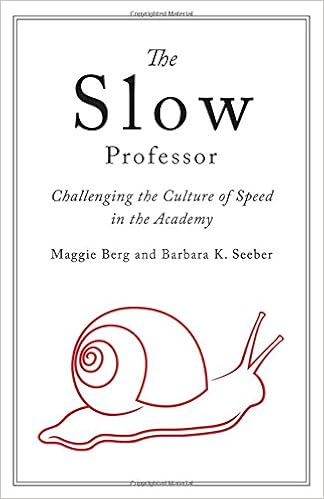
Heard an interview with the authors of Slow Professor: Challenging the Culture of Speed in the Academy by Barbara Seeber and Maggie Berg.

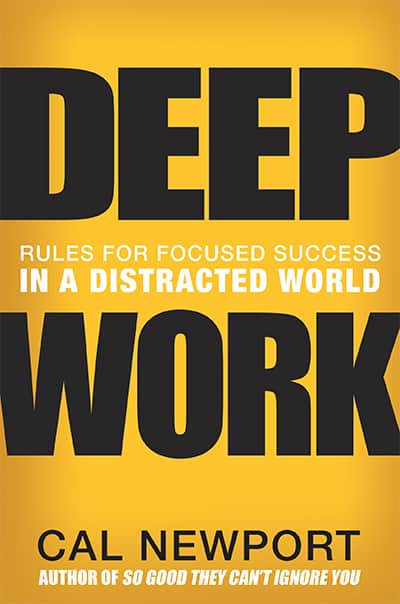
So, I wondered how would that book's ideas compare with the Deep Work book by Cal Newport.

Structure for a piece.


  1. How they are, on the face of it, at odds with each other.
  2. How they are actually similar in important ways. 
    1. the importance of being deliberate
    2. the fix is at the individual level (is that true?)
  3. Some third way, some middle way to reconcile them or improve upon both.
    1. Could have to do with the old guns kill people, people kill people style debate and how the effect of "deliberate work" and the effect of "slow professor" depend neither on who/how uses them and nor does it depend on the inherent features of either idea.

Idea Scraps:
  • Newport's ostensible pragmatism re the moral value, rather the value neutral position, of deep work vs shallow rubs me the wrong way - there's something disingenuous about it. 
Continued...Feb 24th...

I've read a summary article by Seeber and Berg prior to the publication of their book - I'm guessing that it fairly summarizes all of the issues that appear in the book but with fewer supports and fewer references.

While "Deep Work" seems to be about getting more work done more efficiently and making sure that more of the work is meaningful or 'deep', the "Slow Prof" book is about taking time to reflect, and be thoughtful.

While there are these seeming oppositions, both focus on being more deliberate in the academy and at work more generally (esp. deep work). The true differences lie in the fact that Slow Prof focuses on individual resistance to structural changes that prevent deep work. Whereas "Deep Work" focuses on the individual response to the distractions (esp. social media) inherent in modern life. 

So, "Slow Prof" is much more structural and lefty in nature while "Deep Work" is much more 'how to I get along better in the current environment' and is, as such more right politically. Newport even touts, as a badge of honour, his pragmatic amoralism on questions of the ethical values of deep work. His book is about how to thrive in the current system, while Seeber and Berg's is more about resistance to the structural changes we see wrought large in the academy. This is a large difference and not to be made light of. I suspect they would not last long on a sofa at a party. Or, perhaps they'd get into a heated debate. I suspect Newport would have little time for them, and that Seeber and Berg would think him a stuffed shirt, conformist.

However, different their views are, ironically, they both recommend a more a similar prescription: deliberate, deep, slow, thoughtful work as the cure. Newport says it will let you do more of what you want to do. So do Seeber and Berg, how ever they see this as, primarily, a way to resist the corporatization of academic practice. This is interesting since they both come from the same context! 

So, that blows my plan of emphasizing context as a "third way" doesn't it!


Monday, February 20, 2017

Deep Work by Cal Newport

Hmm.

Reading a book called "Deep Work" by Cal Newport. I'm quite into it. The main idea is that we will be happier if we do deep work. Deep work requires us to work at our cognitive limits (cf. Anders Ericsson)

To do deep work we need to limit shallow stuff sufficiently to allow up to a max of 4 hours of deep work. Since deep work requires focus and concentration we have to develop those muscles (he goes over various ways) and we must also limit distractions - he spends a lot of time on reducing use of social media.

Don't take the "Any benefit" approach to new tools.
Rather, take the "craftsman" approach: subtract the downsides, all of them, from the upsides and see if it fit's your deep purpose or deep goals. Only use it if it substantially outweighs the downsides for you and your "project" in life.


  1. Deep work is about learning hard things quickly.
  2. Deep work helps to produce at an elite level -both speed & quality
  • These two core abilities are, Newport says, essential to success in the new economy (unless you own capital, and/or are really good with the new technology. 


He also talks about work places and how to avoid letting email and meetings and shallow stuff take too much of your time. Setting expectations is a big piece of that. So, saying 'no' to light stuff and letting people know what you want to focus on.

Deep work is required to be productive with hard stuff - stuff that requires thought and...depth. So, limiting the shallow stuff let's you do more deep stuff.

If you always jump to avoid boredom when you have a spare second you're training your brain to be panic at boredom and training your brain to be unable to focus deeply - you're always looking for new shiny stimuli. So, do not avoid boredom. It's ok. Sit with it. Do not try to escape it so much.

I like his "process oriented" email idea - reply thoughtfully with a plan of what the next steps are for the other person to do and for you and check in dates to follow up where you let them know when you're available.

The good life comes from the skillful management of attention.
Hours of shallow stuff is not relaxing - it's enervating. Deep work and deep play(my term) are energizing and lead to a good life.

How To Points:


  • make schedules for work time-prioritize deep work, schedule distractions/fun 
  • make schedules for free time- make it deep
  • deep work is not collaborative
  • use rituals and habits to max. deep work

Takes Ideas from Christiensen:
  • focus on the wildly important
  • act on "lead measures" - e.g. "hours spent in deep work" 
  • do not focus on "lag measures" e.g. something after you're done - e.g. awards, or papers published, or reviews - 
  • keep a scoreboard -e.g. hours spent in deep work (meditation?)
Shutdown:
  • make a shut-down ritual (check last email, review schedule, say special words)
  • then do absolutly nothing work related - you need to re-charge and any going back fucks up your mind and stops your batteries from re-charging

Other points:
  • become hard to reach
  • set up expectations
  • set up email filters. e.g. I will reply to email while you are a student of mine. I focus my limited time on my current students to build relationships and help them while they're in my class - I guard my limited time to help my students.

Metaphors of Shame

I heard Steven Pressfield on a recent episode of the Rich Roll podcast (584). My ears perked up when Pressfield began to talk about how our ...