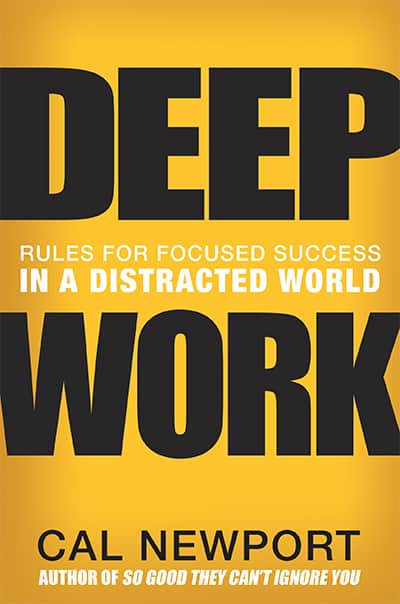
Reading a book called "Deep Work" by Cal Newport. I'm quite into it. The main idea is that we will be happier if we do deep work. Deep work requires us to work at our cognitive limits (cf. Anders Ericsson)
To do deep work we need to limit shallow stuff sufficiently to allow up to a max of 4 hours of deep work. Since deep work requires focus and concentration we have to develop those muscles (he goes over various ways) and we must also limit distractions - he spends a lot of time on reducing use of social media.
Don't take the "Any benefit" approach to new tools.
Rather, take the "craftsman" approach: subtract the downsides, all of them, from the upsides and see if it fit's your deep purpose or deep goals. Only use it if it substantially outweighs the downsides for you and your "project" in life.
- Deep work is about learning hard things quickly.
- Deep work helps to produce at an elite level -both speed & quality
- These two core abilities are, Newport says, essential to success in the new economy (unless you own capital, and/or are really good with the new technology.
He also talks about work places and how to avoid letting email and meetings and shallow stuff take too much of your time. Setting expectations is a big piece of that. So, saying 'no' to light stuff and letting people know what you want to focus on.
Deep work is required to be productive with hard stuff - stuff that requires thought and...depth. So, limiting the shallow stuff let's you do more deep stuff.
If you always jump to avoid boredom when you have a spare second you're training your brain to be panic at boredom and training your brain to be unable to focus deeply - you're always looking for new shiny stimuli. So, do not avoid boredom. It's ok. Sit with it. Do not try to escape it so much.
I like his "process oriented" email idea - reply thoughtfully with a plan of what the next steps are for the other person to do and for you and check in dates to follow up where you let them know when you're available.
The good life comes from the skillful management of attention.
Hours of shallow stuff is not relaxing - it's enervating. Deep work and deep play(my term) are energizing and lead to a good life.
How To Points:
- make schedules for work time-prioritize deep work, schedule distractions/fun
- make schedules for free time- make it deep
- deep work is not collaborative
- use rituals and habits to max. deep work
Takes Ideas from Christiensen:
- focus on the wildly important
- act on "lead measures" - e.g. "hours spent in deep work"
- do not focus on "lag measures" e.g. something after you're done - e.g. awards, or papers published, or reviews -
- keep a scoreboard -e.g. hours spent in deep work (meditation?)
Shutdown:
- make a shut-down ritual (check last email, review schedule, say special words)
- then do absolutly nothing work related - you need to re-charge and any going back fucks up your mind and stops your batteries from re-charging
Other points:
- become hard to reach
- set up expectations
- set up email filters. e.g. I will reply to email while you are a student of mine. I focus my limited time on my current students to build relationships and help them while they're in my class - I guard my limited time to help my students.


No comments:
Post a Comment